Ceiling Contractors for Commercial Projects in Ireland
Choosing the right ceiling contractor is not just a procurement step. It is a building performance decision. In commercial projects, ceilings affect maintenance access, acoustic comfort, fire compliance, lighting coordination, and the long term adaptability of the space. That means the contractor responsible for those systems has a much greater influence on project success than many clients first assume.
Across Dublin, Ireland, and Europe, commercial clients are increasingly looking for ceiling contractors who can do more than simply install a suspended ceiling. They want partners who understand grid systems, technical support frameworks, fire rated assemblies, acoustic requirements, and service coordination above the ceiling line. Manufacturer guides and contractor pages alike now frame ceilings as performance systems rather than cosmetic finishes, especially where service density, access, and compliance matter.
This article explains what specialist ceiling contractors do, the systems they commonly install, why their expertise matters on commercial projects, and how to choose the right contractor for your building. The aim is to give commercial clients practical, decision making insight rather than a generic overview.

What Ceiling Contractors Actually Do
At a basic level, ceiling contractors install suspended ceiling systems. In practice, their role is much broader. They assess layout requirements, interpret ceiling specifications, coordinate with other trades, install support frameworks, set out grids accurately, and ensure the finished ceiling aligns with access, acoustic, and fire requirements. Commercial contractor pages across Ireland emphasise not just installation, but also advising clients and design teams on the most suitable tile and grid systems for the building type.
In offices, that may involve exposed or concealed lay in grid ceilings that balance aesthetics with access. In high specification interiors, contractors may install MF ceilings with concealed support structures to create a smooth plasterboard finish. In technical spaces, the role can expand further into structural support systems such as Unistrut or Tate Grid, where the ceiling zone becomes part of the building infrastructure rather than just a finish. DLS Interiors’ ceiling grid guide separates these systems clearly and identifies different best use cases for Zentia lay in grids, CasoLine MF, Unistrut, Tate Grid, Gordon Grid, and SAS systems.
A useful commercial way to think about ceiling contractors is this: they are not simply fitting a ceiling below the structure. They are shaping how the service zone above the ceiling will work for years. That affects maintenance teams, compliance managers, building users, and future contractors who have to access or modify the building later.
Why Specialist Ceiling Contractors Matter
Not all ceiling contractors bring the same level of value. A specialist ceiling contractor understands that the ceiling is closely tied to building operations. That means they approach the work with a different mindset from a contractor who only sees the ceiling as a final fit out item.
One of the strongest reasons specialist contractors matter is coordination. Ceiling systems intersect directly with lighting, HVAC, sprinklers, alarms, cabling, smoke detection, and structural supports. Armstrong highlights increased load carrying and faster installation as key performance benefits of well designed suspension systems, while Unistrut places strong emphasis on adaptability, centralised overhead infrastructure, and safer modifications over time. Those are not just product claims. They reflect real commercial risks when ceilings and services are poorly coordinated.
The second reason is lifecycle thinking. A standard contractor may focus on getting the ceiling completed. A specialist contractor thinks ahead to service access, future upgrades, tile replacement, and operational disruption. DLS Interiors makes this point clearly in its content on suspended ceiling grids, noting that maintenance access and early specification are crucial to long term serviceability and smoother coordination with M and E services.
The third reason is risk reduction. Fire rated ceilings, acoustic ceilings, and technical support systems all rely on correct installation, not just the right product. Commercial clients often assume specification alone is enough. In reality, ceiling performance depends on the quality of the build, the exact assembly used, and how services interact with the system. That is why specialist ceiling contractors tend to protect value far beyond their package cost.
Ceiling Systems Commonly Installed by Commercial Ceiling Contractors
Commercial ceiling contractors typically work across several categories of ceiling systems, each serving different priorities.
Suspended lay in and exposed grid systems
These are among the most common ceilings in offices, schools, healthcare settings, and retail buildings. Zentia describes suspended ceiling grids as versatile systems available in exposed, semi concealed, and concealed forms, while DLS Interiors notes that Zentia lay in grids are low maintenance, allow quick access to services, and suit offices, schools, healthcare, and commercial units.
For commercial clients, exposed grid ceilings remain popular because they make maintenance easier and keep upfront costs relatively controlled. They also pair well with acoustic tiles and modular lighting, which makes them highly practical in occupied buildings.

Concealed grid and MF ceilings
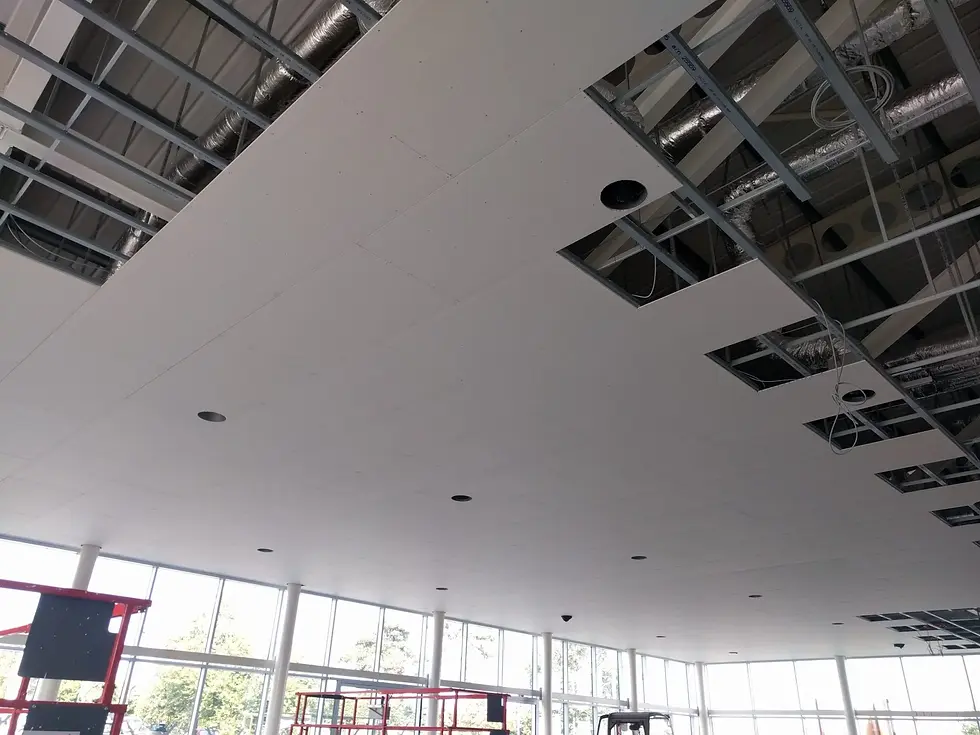
Where visual finish matters more, contractors may install concealed or semi concealed grids, or MF ceiling systems such as CasoLine MF. DLS Interiors describes CasoLine MF as a concealed metal framing system with plasterboard below, suitable for high performance commercial interiors that need a cleaner, more seamless look with fire and acoustic capability.
These systems are often used in boardrooms, reception areas, lobbies, and premium office interiors. The trade off is that they are generally less accessible for routine maintenance than modular lay in systems.
Technical and heavy duty ceiling systems
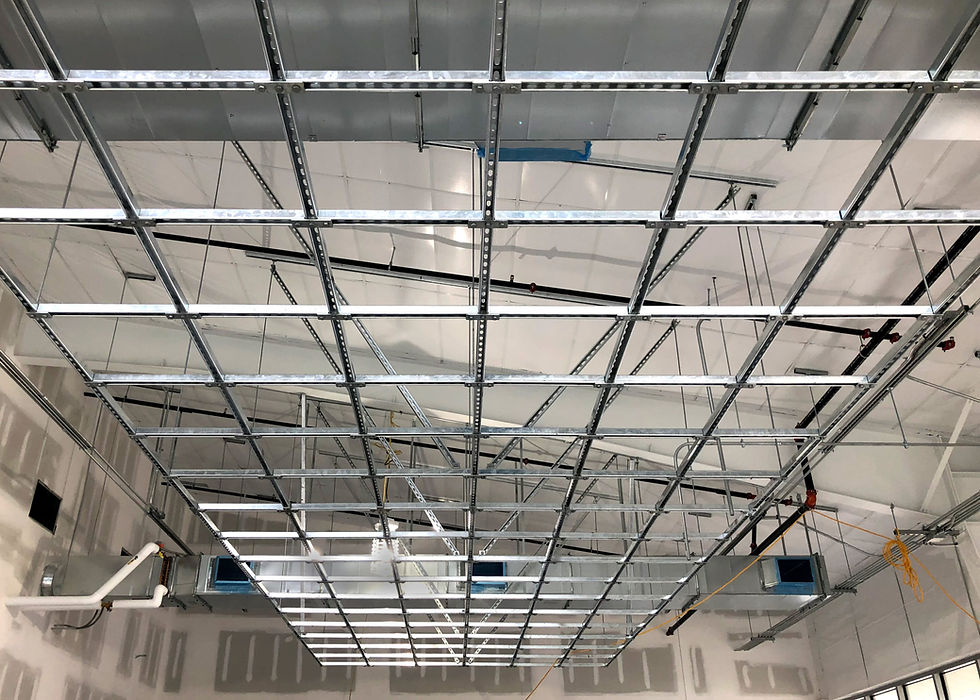
In more demanding environments, commercial ceiling contractors may install Unistrut, Tate Grid, Gordon Grid, or SAS metal ceilings. DLS Interiors identifies Unistrut as a load bearing structural support framework for heavy services, Tate Grid as a pre engineered structural solution for technical spaces, Gordon Grid as an open grid metal ceiling designed for strength and access, and SAS as a precision engineered metal ceiling range offering fire and acoustic performance in sectors such as healthcare and high end offices.
This distinction is commercially important. Once the ceiling zone begins carrying major service loads, the contractor is no longer just installing a finish. They are helping create the infrastructure that supports the building’s operation.
Fire Rated Ceilings and Compliance
Fire performance is one of the clearest areas where experienced ceiling contractors add value. Fire rated suspended ceilings are not simply ceilings with a fire resistant tile. They are full tested assemblies. Hilti’s Irish fire guidance states that the required fire resistance must be guaranteed for fire from above and below the ceiling, and that special requirements apply where modular support systems sit between the structural ceiling and the suspended ceiling. Knauf similarly notes that fire resistant suspended ceiling systems can enhance the fire protection duration of the floor above and support horizontal compartmentation in multi storey buildings.
For commercial clients, that has two implications. First, fire rated ceilings must be specified as systems, not assembled casually from unrelated parts. Second, the ceiling contractor must understand how penetrations, support systems, and perimeter details affect the fire strategy. This matters in offices, schools, healthcare facilities, retail units, multi tenant buildings, and any project with compartmentation requirements.
A useful insight often missing from simple contractor pages is that fire rated ceiling work is as much about coordination as installation. If services are cut into the ceiling without a clear fire strategy, the integrity of the whole assembly can be weakened. That is why commercial clients should view fire rated ceiling contractors as compliance partners, not just installers.

Acoustic Performance and Occupant Experience
Ceilings also shape how a building feels day to day. In commercial offices, education settings, healthcare spaces, and public buildings, acoustic comfort has a direct effect on concentration, communication, and user satisfaction. While tiles or perforated panels deliver the acoustic performance, ceiling contractors still play a central role because the ceiling framework, layout, penetrations, and edge details all influence the final result.
DLS Interiors’ ceiling grid guide notes that Zentia lay in systems offer acoustic options, CasoLine MF can be tailored for acoustic control, and SAS metal ceilings can include acoustic backing. That reinforces a broader point seen across manufacturers as well: the best acoustic ceiling is not just about the tile. It is about how the whole system is specified and installed.
For commercial clients, this matters most in open plan offices, classrooms, meeting spaces, healthcare waiting areas, and circulation zones. A contractor who understands acoustic intent will flag the impact of service penetrations, lighting positions, and tile choice before problems appear on site. That can avoid a common issue in commercial projects where the ceiling technically looks complete but performs poorly for the people using the building.
The commercial insight here is simple. Good acoustic ceilings are rarely accidental. They are usually the result of good coordination between design intent, product choice, and specialist installation.
Service Coordination Above the Ceiling
One of the biggest reasons to appoint experienced ceiling contractors is the complexity of the ceiling void. Above a suspended ceiling, multiple systems often compete for space: ductwork, cable trays, lighting supports, sprinkler pipework, data cabling, alarms, smoke detection, and sometimes specialist supports for equipment. If this area is not coordinated properly, the project can suffer delays, awkward access routes, overloaded grids, or expensive rework later.
Unistrut’s commercial guidance highlights one of the clearest examples of this. It describes ceiling grid systems as modular, adjustable frameworks that simplify overhead support and help centralise infrastructure into an organised, accessible zone. DLS Interiors’ own guidance on structural ceiling systems reflects the same principle for Irish commercial and technical spaces.
For commercial clients, that means the best ceiling contractors are often the ones who think beyond the visible finished ceiling. They ask what services need support, what will need access later, what may change in five years, and where future risk sits. That broader view is often what separates a ceiling package that looks fine on day one from one that still works well after several service upgrades.
This is especially important in buildings with higher service density such as laboratories, healthcare facilities, schools with evolving technology, and technical commercial spaces. In those settings, overhead coordination is not a minor detail. It is one of the main reasons specialist ceiling contractors justify their appointment.
How to Choose Ceiling Contractors in Ireland
Commercial clients often focus first on programme and price. Both matter, but neither should be the first filter. The stronger starting point is capability.
Look first for ceiling contractors with relevant sector experience. Contractor pages in Ireland often point to projects in hospitals, offices, airports, retail, and other commercial buildings. That matters because the right contractor for a school ceiling package may not be the right contractor for a data heavy technical environment.
Next, assess the contractor’s comfort with different ceiling systems. A strong contractor should be able to advise on standard grid ceilings, concealed systems, fire rated assemblies, acoustic performance, and heavy duty support solutions where needed. They should also be able to explain why one option suits the project better than another.
Then look at coordination ability. Ceiling contractors do their best work when they can work closely with the design team, M and E consultants, and site management. If they only talk about installation speed and not about integration, that is a warning sign.
Finally, ask how they think about long term access and change. The strongest ceiling contractors think beyond handover. They understand that services evolve and that maintenance teams need a ceiling system that still works under pressure years later. That mindset is often where real commercial value sits.
Common Mistakes Clients Make When Appointing Ceiling Contractors
One of the most common mistakes is treating ceiling contractors as interchangeable. They are not. Some are strongest in standard suspended ceilings. Others specialise in technical support systems, fire rated assemblies, or premium metal ceilings. Appointing based on price alone can create downstream cost where the ceiling type, service loads, or compliance requirements are more demanding than first assumed.
Another mistake is appointing too late. DLS Interiors’ own grid ceiling guidance stresses the value of early specification because it helps avoid clashes with M and E and supports compliance with fire and acoustic requirements.
A third mistake is failing to define the real function of the ceiling. Does it need quick maintenance access? Acoustic control? Heavy service support? Premium finish? Fire resistance? If the answer is unclear, the contractor is being asked to price a ceiling without a full understanding of what the building needs.
The final mistake is forgetting the building lifecycle. A ceiling that is awkward to access or hard to modify can become expensive very quickly. Ceiling packages should be judged not only on completion cost, but also on how well they support the building over time.
Quick takeaways
Ceiling contractors do far more than install tiles and grids. They influence access, compliance, and building performance.
Specialist contractors add the most value where service density, acoustic control, or fire performance matter.
Standard lay in ceilings suit many offices and schools, while structural systems such as Unistrut or Tate Grid are better for technical environments.
Fire rated ceilings must be installed as tested systems, not pieced together from unrelated parts.
Acoustic success depends on both the selected ceiling product and the quality of the installation.
Early contractor involvement usually reduces clashes, delays, and lifecycle cost.
The best ceiling contractor is the one who understands how the building will operate long after handover.

Conclusion
Commercial clients often think of ceilings as part of the finishing package. In reality, ceilings are one of the most practical performance systems in the building. They shape maintenance access, support services, influence acoustic comfort, contribute to fire strategy, and affect how easily the building can adapt in future.
That is why appointing the right ceiling contractors matters. The best contractors are not simply installers. They are specialists who understand ceiling systems in the context of the whole building. They know when a standard suspended ceiling is enough, when a seamless MF system is the better fit, and when a structural support grid such as Unistrut or Tate Grid is essential for the project. They also understand that compliance, coordination, and future access are just as important as finish quality.
For commercial projects in Dublin, across Ireland, and into wider European markets, that level of expertise can save time, reduce risk, and improve long term value. If you are selecting contractors for an office, school, healthcare scheme, retail building, or technical commercial environment, the strongest question is not simply who can install the ceiling. It is who can help ensure the ceiling performs properly over the life of the building.
FAQs
1. What do ceiling contractors do on commercial projects?
Ceiling contractors install and coordinate suspended ceiling systems, including grids, tiles, support frameworks, and performance assemblies for access, acoustics, and fire compliance in commercial buildings.
2. Why should I use specialist ceiling contractors instead of general contractors?
Specialist ceiling contractors understand system selection, service coordination, fire rated assemblies, and long term maintenance access in a way that general contractors often do not.
3. Can ceiling contractors install fire rated ceilings?
Yes, but the contractor must install the ceiling as a complete tested assembly. Fire performance depends on the full system, not just one product.
4. What ceiling systems do commercial ceiling contractors usually install?
They commonly install exposed grid ceilings, concealed ceilings, MF ceilings, acoustic ceilings, metal ceilings, and structural systems such as Unistrut, Tate Grid, and Gordon Grid.
5. How do I choose the right ceiling contractors in Ireland?
Choose ceiling contractors with relevant commercial experience, strong coordination skills, knowledge of multiple ceiling systems, and a clear understanding of maintenance, fire, and acoustic performance.


