Planning Ceiling and Partition Works in Live Commercial Buildings
Carrying out ceiling and partition works in live commercial buildings is one of the most complex scenarios in interior construction. Offices remain occupied, data centres operate continuously, and healthcare facilities cannot afford disruption. Yet ceilings and partitions still need to be upgraded, repaired, or reconfigured to meet changing operational and compliance requirements.
Planning ceiling and partition works in live commercial buildings requires more than technical skill. It demands careful coordination, risk management, and clear communication, combined with a deep understanding of how buildings function day to day. In Ireland, where many commercial buildings are fully occupied or operational around the clock, this type of work is increasingly common.
This guide explains how to plan ceiling and partition installations in live environments without compromising safety, compliance, or business continuity. It is written for commercial clients, facilities managers, and project teams looking for practical insight rather than generic advice.

Why live commercial environments require a different approach
Working in an occupied building is fundamentally different from working on a vacant site. In a live environment, people, equipment, and business operations are already in place, which significantly increases project risk.
In offices, productivity and comfort must be protected. In data centres, uptime and environmental stability are critical. In healthcare and pharma facilities, hygiene and safety are non negotiable. Any ceiling or partition works must be planned around these realities.
Live buildings also come with unknowns. Services are often undocumented, ceiling voids congested, and previous alterations not reflected in drawings. Without proper planning, these unknowns can lead to delays, rework, and unnecessary disruption.
The key difference is simple. In a live building, success is measured not only by installation quality, but by how little the work impacts the people using the space.
Understanding the risks of working in occupied spaces
Before planning begins, it is essential to understand the risks associated with ceiling and partition works in live commercial environments.
Dust is one of the most common challenges. Ceiling access, drilling, or partition removal can release fine particles that affect air quality, sensitive equipment, and occupant comfort. This is particularly critical in data centres and healthcare buildings, where dust can have operational consequences.
Noise is another major consideration. Ceiling works often involve drilling, cutting metal grids, or fixing framing systems. Excessive noise during working hours can disrupt meetings, patient care, or essential operations.
There is also the risk of unplanned service disruption. Ceilings and partitions conceal electrical, data, fire, and mechanical services. Any accidental interference can trigger alarms, outages, or safety incidents.
Understanding these risks early allows them to be mitigated through structured planning, sequencing, and communication.
Early planning and site assessment
Successful planning ceiling and partition works in live commercial buildings always starts with a detailed site assessment.
This should include a full walk through of the affected areas, including ceiling voids, risers, and adjacent spaces. The aim is to understand what exists on site, not just what appears on drawings.
Existing services should be identified and verified. In many older Irish commercial buildings, drawings are incomplete or outdated. Physical verification is essential before works begin.
Access logistics also need careful consideration. How materials enter the building, where waste is removed, and how lifts or loading bays are used can all affect the programme. These issues are often overlooked but have a direct impact on disruption levels.
For clients planning complex projects, engaging an experienced contractor early, such as DLS Interiors, allows potential issues to be identified before they become site problems. You can explore our full scope of work on our Services page.
Stakeholder coordination and communication
One of the most underestimated aspects of live commercial projects is stakeholder coordination.
Live buildings often involve building owners, managing agents, facilities teams, tenants, security, and other contractors. Each group has different priorities and concerns.
Clear communication from the outset is essential. This includes explaining the scope of works, timelines, potential impacts, and mitigation measures. Regular updates help manage expectations and reduce frustration.
For larger projects, appointing a single on site point of contact improves coordination and accountability. This person manages access, responds to issues, and ensures agreed procedures are followed.
Early engagement with facilities management teams is particularly important in Ireland, where permit systems and compliance requirements are common.
Phasing works to minimise disruption
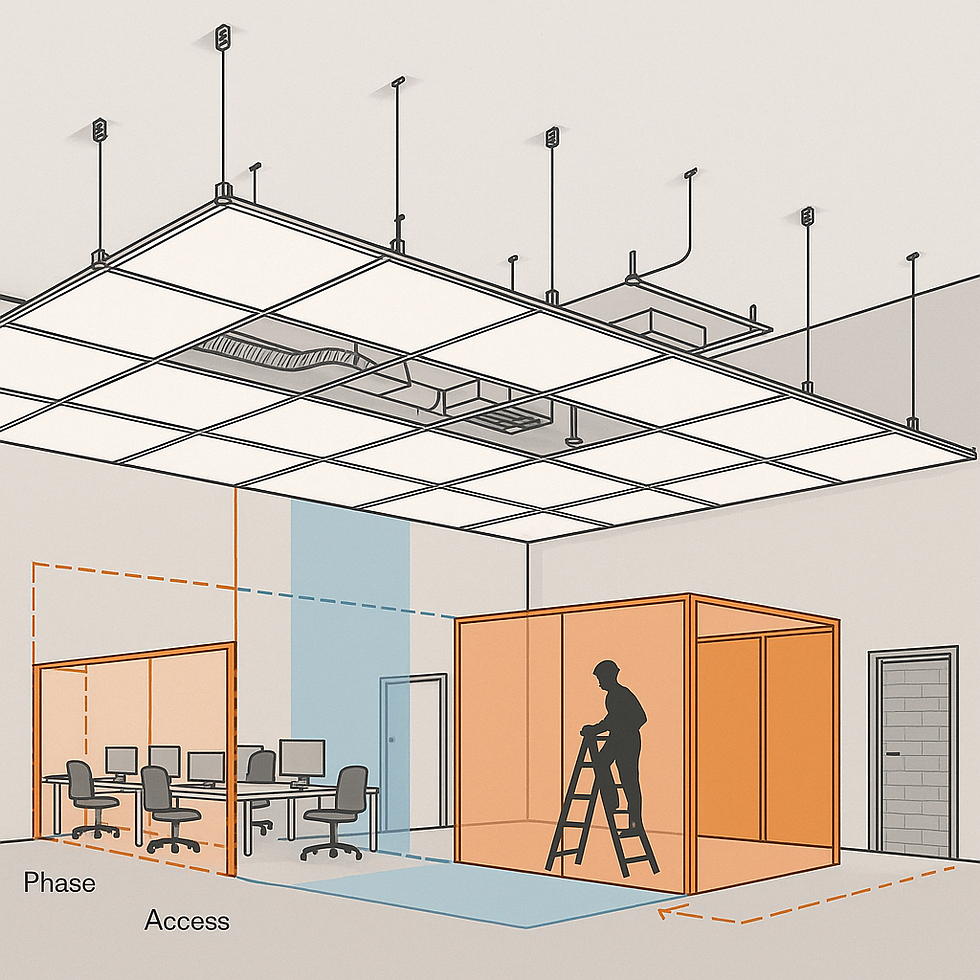
Phasing is one of the most effective strategies when planning ceiling and partition works in occupied buildings.
Instead of working across a large area at once, projects are broken into smaller zones. This allows parts of the building to remain operational while works progress in a controlled manner.
In office environments, this may involve working floor by floor or department by department. In data centres, phasing is often planned by room, aisle, or zone.
Phasing also reduces risk. If issues arise in one area, they can be resolved without impacting the wider building. This approach is especially valuable where ceilings support services or critical infrastructure.
Out of hours and weekend working strategies
In many live commercial environments, the most effective way to reduce disruption is to carry out ceiling and partition works outside normal operating hours.
Evening, night, or weekend working allows noisy and dusty activities to be completed when buildings are empty or lightly occupied. This approach is common in offices, retail spaces, and public buildings across Ireland.
However, out of hours working must be carefully managed. Security access, lighting, welfare facilities, and noise restrictions still apply. Fatigue management is also important to maintain quality and safety.
A balanced approach often works best. Quiet tasks such as layout, setting out, and finishing can be completed during the day, while disruptive works are scheduled out of hours.
Dust, noise, and environmental control measures
Managing dust and noise is central to successful live building projects.
Dust control measures may include temporary enclosures, sealed work zones, extraction units, and protective coverings. In ceiling voids, sensitive equipment below must be protected at all times.
Noise control can involve low noise tools, vibration reducing fixings, and strict time windows for disruptive activities. Clear communication with occupants about when noise will occur helps manage expectations.
In sensitive environments such as healthcare or data centres, additional environmental monitoring may be required. This could include air quality checks or temperature monitoring following ceiling works.
Coordination with services above ceilings and within partitions
Ceilings and partitions are closely linked to mechanical, electrical, fire, and data services.
When planning works in live buildings, coordination with these services is critical. This includes identifying service routes, understanding load requirements, and ensuring services remain supported and operational.
Ceiling systems often support lighting, cable trays, and air diffusers. Any changes must ensure these elements are reinstated correctly and safely.
A key lesson from live projects is the value of early coordination workshops. Bringing together ceiling installers, MEP contractors, and facilities teams before work starts avoids clashes and rework later.
You can read more about how services interact with ceiling systems in our related blog post on installing services above suspended ceilings, available in the blog section of our website.
Health, safety, and compliance in live environments
Health and safety takes on added importance in occupied buildings.
Risk assessments must consider not only operatives, but also building users. This includes segregation of work areas, safe access routes, and clear signage.
Fire safety is a critical consideration. Temporary removal of ceilings or partitions can affect fire compartmentation and detection systems. These impacts must be managed and reinstated promptly.
Compliance with Irish building regulations and client standards is essential throughout the project lifecycle.
Quality control and inspection during live works
Maintaining quality under live conditions requires structured inspection and oversight.
Ceilings must be level, aligned, and visually consistent, as defects are immediately noticeable in occupied spaces. Partition finishes must meet specification despite access and time constraints.
Agreeing inspection points with clients or facilities teams builds trust and ensures issues are addressed before areas are handed back into use.
Quick takeaways
Live commercial buildings require a different planning approach
Early site assessment reduces risk and disruption
Phasing and out of hours working protect operations
Dust and noise control must be actively managed
Service coordination is essential
Safety and compliance must be maintained at all times
Conclusion
Planning ceiling and partition works in live commercial buildings is complex, but entirely manageable with the right approach. Success depends on understanding how the building operates, coordinating with stakeholders, and sequencing works to minimise disruption.
For commercial clients in Ireland, investing time in planning delivers long term value. It protects occupants, maintains operations, and reduces the risk of delays or disputes.
At DLS Interiors, we specialise in delivering ceiling and partition installations in live commercial environments across Ireland and Europe. Our experience allows us to plan carefully, coordinate effectively, and complete works with minimal disruption.
If you are planning ceiling or partition works in an occupied building, explore our experience on the Projects page or get in touch via our Contact page.
FAQs
1. Can ceiling works be carried out during office hours?
Yes, but disruptive tasks are usually scheduled out of hours, with quieter activities completed during the day.
2. How is dust controlled during live works?
Through enclosures, extraction, protective coverings, and frequent cleaning.
3. Is out of hours working more expensive?
It can be, but it often reduces overall disruption and project risk.
4. How are services protected during ceiling works?
By identifying and supporting services in advance and coordinating with MEP teams.
5. What is the biggest risk in live commercial projects?
Poor planning and assumptions about existing conditions.


