Suspended Ceiling Cost in Ireland: What Affects Pricing?
Suspended ceiling cost in Ireland can vary depending on the ceiling system, tile type, grid specification, room size, ceiling height, acoustic or fire performance, access, services integration and installation requirements. For commercial buildings, a suspended ceiling is usually priced based on the area involved, the materials specified and the complexity of the installation.
A professional site survey or detailed quotation is the best way to get an accurate figure. A contractor such as DLS Interiors can advise on the right suspended ceiling system for your commercial space, especially where the project also involves partitions, services coordination or wider refurbishment works.

Quick Answer: How much does a suspended ceiling cost in Ireland?
Suspended ceiling costs in Ireland can vary by specification and project size.
Commercial ceilings are usually priced based on area, materials and installation complexity.
Acoustic, fire rated, moisture resistant or hygiene ceiling tiles may increase costs.
Existing ceiling conditions, access, lighting, HVAC and out of hours work can affect pricing.
A site survey gives the most accurate figure.
Any cost guidance should be treated as a typical guide range, not a fixed quotation.
What Is a Suspended Ceiling?
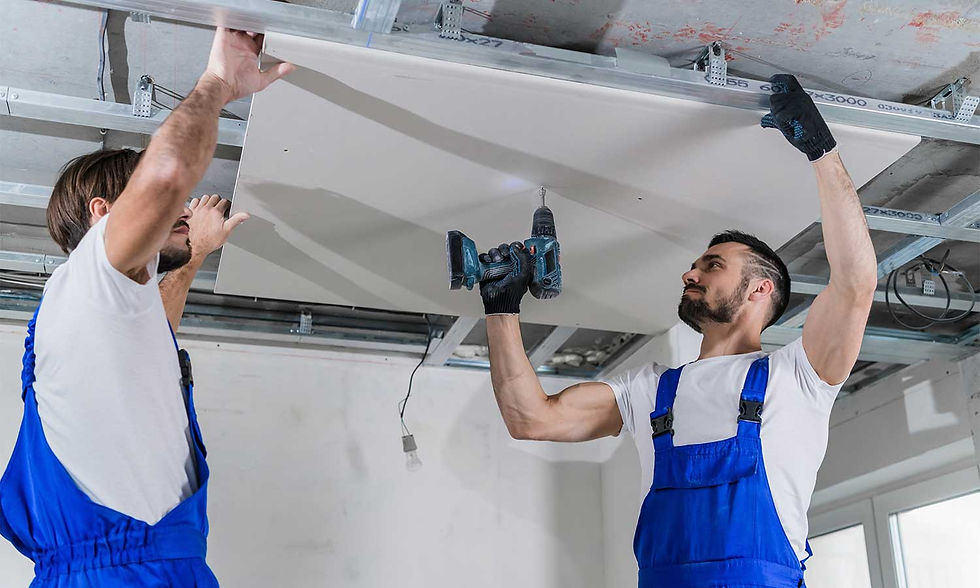
A suspended ceiling is a secondary ceiling system installed below the structural ceiling or roof deck. It usually includes a ceiling grid, ceiling tiles or panels, suspension wires and a void space above the finished ceiling line.
Suspended ceilings are common in offices, schools, healthcare buildings, retail units, hospitality spaces, industrial areas and other commercial buildings because they can provide a practical balance of appearance and function.
A suspended ceiling can help with:
Easy access to services such as lighting, cabling, ventilation and sprinklers.
Improved acoustic performance in offices, classrooms, meeting rooms and shared spaces.
A clean commercial finish that hides exposed services and creates a professional appearance.
Flexible replacement of individual ceiling tiles where maintenance access is required.
Coordination with lighting, ventilation grilles, access panels and fire safety systems.
DLS Interiors positions itself as a specialist ceiling and partition contractor, with services covering suspended systems, partition installations and hot aisle containment systems across commercial and technical environments.
How Much Does a Suspended Ceiling Cost in Ireland?
Exact pricing should always be confirmed through a site survey or formal quotation. Without drawings, site information and specification details, it is not reliable to provide a fixed rate.
The table below gives a practical cost level guide rather than guaranteed prices.
Ceiling type | Typical use | Cost level | Key pricing factors | Notes |
Basic commercial suspended ceiling | Storage areas, basic offices, back of house spaces | Low to medium | Area, grid type, standard tiles, access | Often used where a practical finish is required |
Standard office suspended ceiling | Offices, meeting rooms, commercial workspaces | Medium | Tile finish, ceiling height, lighting, HVAC | Common choice for office refurbishment projects |
Acoustic suspended ceiling | Open plan offices, classrooms, call areas, meeting rooms | Medium to high | Acoustic tile rating, room use, surrounding construction | Useful where noise control or comfort matters |
Moisture resistant suspended ceiling | Toilets, changing areas, humid spaces | Medium to high | Tile specification, ventilation, room conditions | Specification should suit moisture exposure |
Fire rated ceiling system | Commercial areas with defined fire performance requirements | High | Tested system, installation detail, services, professional specification | Fire requirements must be reviewed by competent professionals |
Hygiene or clean room style ceiling tiles | Healthcare, pharmaceutical, controlled environments | High | Hygiene performance, cleanability, sealed details | Suitable where maintenance, cleaning or contamination control matters |
Bespoke or high spec commercial ceiling | Data centres, premium commercial spaces, technical environments | Premium | System type, access, load, services, specialist detailing | Usually requires detailed design coordination |
DLS Interiors’ services page states that the company provides high performance ceiling and partition systems for demanding commercial environments, including modern office developments and mission critical data centres.
What Affects Suspended Ceiling Pricing?
Suspended ceiling prices in Ireland are shaped by more than the size of the room. The final quotation usually depends on material specification, installation complexity and site conditions.
Size of the Area
Larger ceiling areas usually require more tiles, grid components, suspension materials and labour. However, larger spaces may sometimes be more efficient to install than several smaller rooms because access, setting out and workflow can be simpler.
Ceiling Height
Higher ceilings can increase cost because they may require access equipment, additional safety planning and more time on site. Ceiling height also affects how the grid is set out and how services are coordinated above the ceiling line.
Type of Grid System
The ceiling grid specification can affect both material cost and installation time. Standard lay in grid systems are common in commercial buildings, while specialist grid systems may be required for heavy duty, technical or data centre environments.
DLS has published guidance on grid ceiling installation and specialist ceiling systems, including how grid ceilings can support service access, load requirements and commercial performance.
Ceiling Tile Specification
Ceiling tiles vary significantly. Basic tiles, acoustic tiles, moisture resistant tiles, hygiene ceiling tiles, fire rated tiles and specialist metal panels all sit at different cost levels. The right choice should depend on the use of the space, not just the lowest material price.
Acoustic Requirements
Acoustic suspended ceiling tiles may be needed in open plan offices, meeting rooms, classrooms, reception areas, call areas and shared commercial spaces. These tiles are designed to help absorb sound and improve comfort, although performance also depends on partitions, finishes, doors, seals and surrounding construction.
Fire Performance Requirements
Fire rated ceiling systems can increase cost because the system must be specified correctly and installed in line with the required performance. Requirements can depend on building design, use, escape routes, services and professional specification.
Ireland’s Technical Guidance Document B provides official guidance on fire safety for buildings other than dwelling houses, so fire related ceiling requirements should be reviewed by qualified professionals as part of the wider project design.
Moisture or Hygiene Requirements
Spaces such as toilets, changing rooms, healthcare areas, laboratories or controlled environments may require tiles that are easier to clean, more resistant to moisture or suitable for hygiene sensitive areas.
Lighting Integration
LED panels, emergency lighting and feature lighting can all affect the ceiling layout, grid coordination and installation sequence.
HVAC and Ventilation Integration
Air conditioning units, ventilation grilles and ductwork need to be coordinated with the ceiling grid and tiles. Poor coordination can create delays, rework and access issues.
Sprinklers, Alarms, Sensors and Access Panels
Sprinkler heads, smoke detectors, fire alarms, security sensors and access panels may all need to be integrated into the ceiling. Each item can affect labour, sequencing and layout planning.
Existing Ceiling Condition
If an old ceiling needs to be removed, or if the existing grid is damaged, poorly aligned or unsuitable, replacement costs can increase. Waste removal and making good should also be considered.
Site Access and Working Hours
Projects in live commercial buildings may need phased installation, dust control, restricted access or out of hours work. DLS has published guidance on planning ceiling and partition works in live commercial buildings, including the need for careful coordination, risk management and clear communication.
Project Location in Ireland
Location can affect travel, delivery, access, parking, loading and programme planning. City centre projects may involve different access constraints compared with business parks, schools, industrial units or healthcare buildings.
Suspended Ceiling Cost by Project Type
Project type | Typical requirements | Pricing complexity | Key considerations |
Small office ceiling replacement | Replace ceiling tiles, review existing grid, minor making good | Low to medium | Existing grid condition, tile type, access |
Open plan office suspended ceiling | Larger ceiling area, lighting coordination, HVAC integration | Medium | Grid layout, acoustic needs, services |
Meeting room with acoustic ceiling tiles | Acoustic tile specification, lighting, possible partition interfaces | Medium to high | Speech privacy, reverberation, doors and partitions |
Retail unit ceiling upgrade | Appearance, lighting, customer facing finish, access | Medium | Programme, trading hours, feature lighting |
School or education facility ceiling works | Acoustic comfort, durability, phased works, maintenance access | Medium to high | Holiday programme, safety, access, room use |
Healthcare or hygiene sensitive ceiling area | Cleanable tiles, moisture resistance, access, hygiene requirements | High | Specification, cleaning needs, services coordination |
Commercial refurbishment with ceilings and partitions | Ceiling grid, partition interfaces, services, finishes | Medium to premium | Whole project coordination, phasing, disruption control |
Are Acoustic Suspended Ceilings More Expensive?
Acoustic suspended ceilings can cost more than basic ceiling systems because the tiles are designed to improve sound absorption and reduce echo within a space. The extra cost may be worthwhile in commercial environments where noise control affects comfort, communication or productivity.
Acoustic ceiling tiles are often considered for:
Open plan offices
Meeting rooms
Classrooms
Call areas
Healthcare settings
Reception areas
Shared commercial environments
However, acoustic performance does not depend on ceiling tiles alone. Partitions, doors, seals, wall finishes, flooring, furniture and surrounding construction can all affect how sound behaves in a room.
The Health and Safety Authority provides information on workplace noise and the regulations that protect workers from noise exposure, which reinforces the importance of considering noise as part of wider workplace design and risk management.
If your project involves both ceilings and partitions, it is worth reviewing the full room build up. DLS provides ceiling and partition services for commercial projects where access, acoustics, fire performance and service coordination need to be considered together.
Do Fire Rated Suspended Ceilings Cost More?
Fire rated suspended ceilings can cost more than standard ceiling systems because they may require specific tested components, careful installation details and coordination with other building elements.
Fire performance should never be guessed. Requirements may depend on:
Building design
Building use
Escape routes
Compartmentation
Services above or passing through the ceiling
Fire strategy
Professional specification
This article is not legal or fire safety advice. Project specific requirements should be confirmed by the design team, fire consultant, assigned certifier or other qualified professional.
From a pricing perspective, fire rated systems may increase cost because they can involve higher specification materials, additional detailing, more complex installation and closer coordination with penetrations, lights, vents and access points.
How Do Lighting, HVAC and Services Affect the Cost?
Suspended ceilings often interact with multiple building services. This is one of the main reasons commercial ceiling installation cost can vary from project to project.
Ceiling works may need to coordinate with:
LED lighting
Emergency lighting
Air conditioning
Ventilation grilles
Sprinklers
Smoke detectors
Access panels
Data systems
Security systems
Fire alarm devices
Each service can affect the ceiling grid layout, tile cuts, labour time and installation sequence. Where services are being moved or replaced, the ceiling contractor may need to coordinate closely with electrical, mechanical and fire safety contractors.
For an accurate figure, a site survey is usually the best starting point.
Suspended Ceiling Replacement vs New Installation
Replacing an existing suspended ceiling can be simpler than installing a new system, but only if the existing grid and suspension system are suitable. If the grid is damaged, outdated, misaligned or not suitable for the new tile specification, a full replacement may be the better option.
Factor | Replacement ceiling | New suspended ceiling | Cost impact |
Removing old tiles | Usually required | Not applicable unless existing ceiling is present | Adds labour and waste handling |
Reusing existing grid | May reduce cost if suitable | New grid required | Existing grid condition is key |
Suspension system | Must be checked | Installed as part of new system | Poor condition can increase cost |
Layout changes | May be limited by existing grid | More flexibility | New layouts can increase coordination |
New lighting or services | May require tile cuts or grid changes | Can be planned from the start | Service integration can increase cost |
Waste disposal | Old tiles may need disposal | Packaging and offcuts only | Removal and disposal should be priced |
Making good | May be required | Usually part of new finish planning | Depends on existing conditions |
How to Reduce Suspended Ceiling Costs Without Cutting Corners
The goal should not be to choose the cheapest system possible. The goal should be to choose a fit for purpose specification that suits the building, budget and long term use of the space.
Practical ways to manage cost include:
Finalise the layout early.
Choose the right tile specification for the space.
Avoid unnecessary premium finishes where they are not required.
Coordinate lighting and services before installation.
Combine ceiling and partition works where appropriate.
Plan out of hours work carefully.
Request a clear scope of works.
Arrange a site survey before committing to a budget.
Good whole project planning can help reduce delays, avoid rework and improve cost certainty.
If your project also involves partitions, drylining or wider commercial interior works, early coordination can make the installation process smoother.
Why the Cheapest Suspended Ceiling Quote Is Not Always the Best
A low suspended ceiling quote can look attractive at first, but it may not include the right specification, service coordination or finishing detail.
Potential risks include:
Poor finish
Low quality tiles
Weak acoustic performance
Incorrect specification
Poor integration with services
Delays
Rework
Shorter lifespan
Lack of clarity in the quote
For commercial clients, value comes from correct specification, reliable workmanship and a ceiling system that performs properly over time. A ceiling in an office, school, healthcare facility, retail unit or technical environment needs to support the way the building is used.
What Should Be Included in a Suspended Ceiling Quotation?
A clear quotation should explain what is included, what is excluded and what assumptions have been made.
Useful items to check include:
Area to be covered
Ceiling system type
Tile specification
Grid specification
Ceiling height
Access requirements
Service integration
Removal of existing ceiling, if applicable
Waste disposal
Out of hours requirements
Programme and phasing
Exclusions
Any assumptions
Warranty or workmanship details, if available
If a quote is unclear, ask for clarification before works begin. This can help reduce misunderstandings and unexpected costs later.
How to Get an Accurate Suspended Ceiling Cost in Ireland
To prepare an accurate suspended ceiling quotation, a contractor will usually need:
Drawings or measurements
Photos of the space
Site address
Ceiling height
Existing ceiling condition
Preferred tile type
Acoustic or fire requirements
Lighting and HVAC details
Programme or deadline
Details of any partitions, drylining or wider refurbishment works
A contractor such as DLS Interiors can review the ceiling requirements, advise on suitable systems and help identify coordination points before the project starts. To discuss your next commercial ceiling project, contact DLS Interiors for advice or a tailored quotation. The DLS contact page states that the team supports commercial ceiling installations, partition systems and hot aisle containment projects across Dublin, Ireland and Europe.
Quick takeaways
Suspended ceiling cost in Ireland can vary depending on the ceiling system, tile type, room size, ceiling height, access and installation requirements.
Commercial suspended ceilings are usually priced based on the area, material specification and level of installation complexity.
Acoustic, fire rated, moisture resistant or hygiene ceiling tiles may increase the overall cost depending on the project requirements.
Lighting, HVAC, sprinklers, alarms, sensors and access panels can all affect the final quotation.
Replacing ceiling tiles may cost less than installing a full new suspended ceiling, but only if the existing grid and suspension system are suitable.
The cheapest quote is not always the best option. A fit for purpose specification can help reduce rework, delays and long term maintenance issues.
A site survey is the best way to get an accurate suspended ceiling quotation for a commercial project in Ireland.

Conclusion
Suspended ceiling costs in Ireland depend on the system specification, ceiling tile type, room size, acoustic requirements, fire performance, access, services coordination and overall installation complexity.
The right suspended ceiling system should balance cost, appearance, access, acoustic performance, compliance needs and long term value. For commercial clients, the cheapest quote is not always the best result. A well planned ceiling package can reduce disruption, improve usability and support the long term operation of the building.
Speak to DLS Interiors about suspended ceiling installation for your next commercial project in Ireland or Europe.
FAQs
1. How much does a suspended ceiling cost in Ireland?
Suspended ceiling cost in Ireland can vary depending on the ceiling system, tile type, area, ceiling height, acoustic or fire requirements, access and installation complexity. A site survey or detailed quotation is the best way to get an accurate figure.
2. What affects the price of a suspended ceiling?
The main pricing factors include area size, ceiling height, grid type, tile specification, acoustic performance, fire requirements, lighting, HVAC, access, existing ceiling condition, working hours and project location.
3. Are acoustic ceiling tiles more expensive?
Acoustic ceiling tiles are often more expensive than basic tiles because they are designed to improve sound absorption and comfort. They may be worthwhile in offices, meeting rooms, classrooms and shared commercial environments.
4. Can a suspended ceiling improve office acoustics?
Yes, a suspended ceiling can help improve office acoustics when suitable acoustic tiles are specified. Performance also depends on the room layout, partitions, doors, flooring and surrounding finishes.
5. Do suspended ceilings need to be fire rated?
Some suspended ceilings may need fire performance depending on the building design, use, escape routes and professional specification. Project requirements should be confirmed by qualified professionals.
6. Is it cheaper to replace ceiling tiles or install a new suspended ceiling?
Replacing ceiling tiles may be cheaper if the existing grid and suspension system are in good condition. If the grid is damaged, unsuitable or poorly aligned, a new suspended ceiling may provide better long term value.
7. How long does suspended ceiling installation take?
Installation time depends on the size of the area, ceiling height, specification, site access, services coordination and whether the building is occupied. Larger or phased commercial projects may take longer.
8. Can lighting and ventilation be fitted into a suspended ceiling?
Yes, suspended ceilings are commonly coordinated with LED lighting, emergency lighting, ventilation grilles, air conditioning, sprinklers, smoke detectors and access panels.
9. Do I need a site survey for a suspended ceiling quote?
A site survey is strongly recommended for commercial suspended ceiling projects. It helps confirm measurements, ceiling heights, existing conditions, access, services and any acoustic or fire related requirements.